Actualités
16 April 2026
Teaching in national languages is one of the options identified by the government, through the Sectoral Strategy for Education and Training (SSEF 2016–2025), to improve the quality of education in the Democratic Republic of the Congo. This document, which outlines several planned reforms in the education sector, advocates for “the use of national languages as a vehicle for teaching and learning.”
Both experts and scientific studies have demonstrated the benefits of teaching in national languages. Studies show that children who learn to read in their first language are able to learn easily in a second language, such as French or English. Furthermore, they will be able to write and share their own knowledge and experiences with the rest of the world.
In September 2022, Dr. Isaias Barreto Da Rosa, UNESCO’s representative in the DRC, was already speaking about the need to integrate local languages into preschool curricula: “Mother tongues (…) are an important factor for access to endogenous and universal knowledge and for the quality of learning,” he noted.
According to him, national or local languages are a major asset in terms of the quality of learning: “Evaluations of experiences using mother tongues in education show that the quality of learning is improved across various academic disciplines, including foreign language learning,” he noted.
“Children do not go to school to learn a language, whether it be French or English,” stated OTTO Michel, an expert consultant on early childhood education in the DRC, in June 2022 during a press conference. He added: “Children go to school for knowledge and science. These are conveyed through a medium: language, regardless of which one. What matters is that it is a language the child understands and through which they can communicate.”
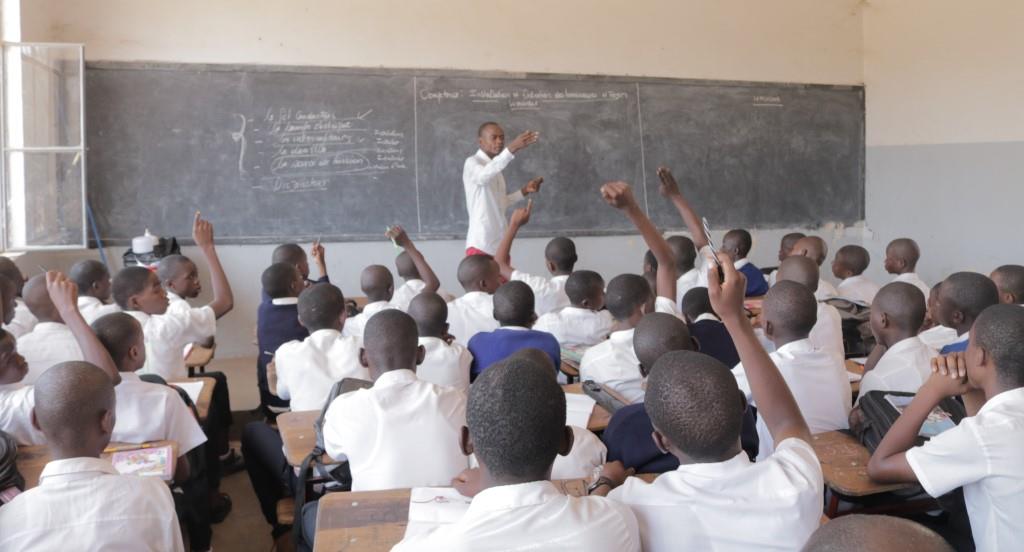
For Régine Yala, a second-grade kindergarten teacher at the Manyanga school complex in the Gombe district of Kinshasa, the national language or local language facilitates understanding of activities: “When we teach, certain words do not allow children to understand immediately. That’s why we use a little Lingala to make ourselves understood,” she said. She also notes resistance from some parents: “Some parents don’t make our job easy when they find out we use a little Lingala to teach their children,” she laments.
Learning in the national language also relates to another inalienable right of the child: the right to cultural identity. For Nelly Lubuma, director of the Ecole Chrétienne Bénie, a private school based in Kinshasa, cultural identity begins with teaching children the national languages:
“We are Congolese and we will remain so. As such, we have our languages. Language is part of a people’s identity. Children must learn to sing in Tshiluba, Kikongo, Lingala, and Swahili. For us, this is respect for the child’s right to cultural identity,” she says.
“Languages are born, evolve, and disappear,” as the saying goes. Textbooks and specific curricula in national languages must be produced and widely distributed to preserve traditional culture and keep it alive. Everyone—adults, teenagers, and school-age children—must keep in mind that language constitutes cultural heritage, and that there are no Bangala without Lingala, no Bakongo without Kikongo, and so on.
Textbooks in national languages can easily teach children cultural values and concepts that are difficult to understand when expressed in a foreign language. Thus, with textbooks in national languages, they will better learn the history, culture, and traditions of their country, which they will pass down from generation to generation. Language is the temple of a people’s cultural identity; it is sacred. As such, it deserves respect and consideration.
National languages are also an asset for the transmission of spiritual values. Children can easily grasp the sacred scriptures if they read them in local languages. In this way, they learn without much effort to pray according to the recommendations given in the scriptures and to develop a good relationship with God. In this way, they will be in harmony with the religion practiced in their community.
PAQUE’s Support
The need for learning in the national language is being addressed with the support of the Project for the Improvement of Education Quality (PAQUE). Since January 2022, thanks to this project, a new national program for kindergarten has been unveiled. This program also incorporates instruction in local languages and is expected to be fully implemented so that the various related reforms can now be put into practice.
PAQUE has drawn on the reform guidelines outlined in the SSEF2016-2025 to launch a campaign distributing reading and writing textbooks in the four national languages: Tshiluba, Kikongo, Swahili, and Lingala. It is in this context that more than 10 million of these textbooks have been distributed. These textbooks are designed primarily for students. They are adapted to the students’ learning levels.
Inspectors and teachers, for their part, have received training on teaching methods in national or local languages.
Thierry MBEBANGU and Bruno NSAKA
Filter by structure or document type to find the right content.



For any report or information related to national education and new citizenship, call 178