Children and the SDGs: a priority for the DRC ("Tribune de la Ministre d'État, Raïssa Malu, Ministre de l'Éducation Nationale et Nouvelle Citoyenneté répondant aux défis révélés dans le rapport national")
Introduction
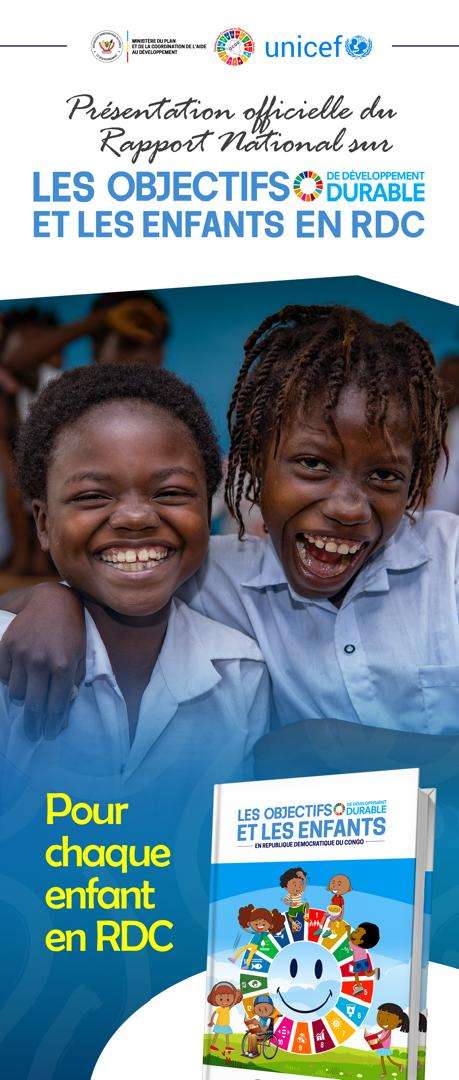
The National Report on Children and the Sustainable Development Goals (SDGs) in the Democratic Republic of the Congo, November 2023, is a key document for understanding the situation of children in the face of current challenges and the progress needed to achieve the SDGs. It was produced at the initiative of the Ministry of Planning and Coordination of Development Aid with the support of the Congolese Observatory for Sustainable Development.
Officially presented on December 17, 2024, this report paints an alarming picture of the living conditions of Congolese children. Drawing on accurate and up-to-date data, it highlights major issues such as multidimensional poverty, child malnutrition, difficulties in accessing quality education, children’s fragile health, and their vulnerability to climate crises and armed conflicts.
As the foreword to this report so aptly states:
“This report aims to enlighten, inspire, and mobilize all efforts toward greater collective commitment to accelerating progress toward the realization of children’s rights with a view to achieving the SDGs in the DRC.”
The publication of this report comes at a time when the DRC is at a decisive turning point. Faced with persistent structural challenges, it is imperative to strengthen national efforts to ensure a better future for Congolese children. In particular, the Ministry of National Education and New Citizenship is at the heart of the solutions to be implemented, thanks to the strategic initiatives outlined in the 2024–2029 Five-Year Plan.
Through concrete actions such as the development of a national school feeding strategy, with support from the World Food Programme (WFP), and the implementation of a national strategy for education in emergencies, the ministry is taking action to address the challenges identified in this report and actively contribute to achieving the SDGs.
An alarming situation: key statistics related to the SDGs
The National Report on Children and the SDGs in the DRC highlights the considerable challenges facing the country’s children. By structuring its findings around the 17 Sustainable Development Goals (SDGs), the report presents a concerning assessment of the living conditions of Congolese children while emphasizing the urgent need for action to improve their daily lives and their future.
According to SDG 1 (No Poverty), it appears that Congolese households with children are hit hardest by poverty. The poverty rate stands at 76.9% for these households, compared to 44.7% for those without children. This finding highlights the heightened vulnerability of children in economically disadvantaged households, where basic needs are not always met. Furthermore, 74.6% of Congolese children are identified as multidimensionally poor, meaning they are deprived of several fundamental rights, including access to education, health care, and nutrition.
Hunger and malnutrition, as outlined in SDG 2 (Zero Hunger), constitute a major problem. The report estimates that 6 million children in the DRC are affected by malnutrition. Among them, 3.7 million under the age of 5 suffer from acute malnutrition and 1 million from severe acute malnutrition. This reality has dramatic consequences: nearly 42% of Congolese children suffer from stunted growth, compromising their physical and cognitive development. Malnutrition is also responsible for 31.5% of deaths among children under 5, an alarming statistic that underscores the urgency of appropriate food strategies.
SDG 3 (Good Health and Well-being) reveals that infant mortality remains high despite notable progress. The under-5 mortality rate fell from 96.5 deaths per 1,000 live births in 2015 to 79 in 2020, while neonatal mortality decreased to 26.5 deaths per 1,000. However, malaria remains a major scourge: it accounts for 67.3% of deaths among children under 5, who represent 48.7% of detected cases. Furthermore, mother-to-child transmission of HIV still affects 29.7% of children born to HIV-positive women, with 70,900 children living with HIV/AIDS in 2020.
In terms of education (SDG 4), the figures reflect a persistent crisis. Only 5% of children aged 3 to 5 are enrolled in the final pre-primary level. Despite free primary education, one-third of children enrolled in primary school do not complete this level, and two-thirds of children do not finish secondary school. Quality challenges remain just as pressing: more than 74% of students do not meet the minimum reading threshold in Congolese languages, and only 16% reach this level in French.
SDG 5 (Gender Equality) highlights persistent inequalities in access to education. While the gender parity index stands at 0.93 in primary school, it drops to 0.82 in lower secondary school and to 0.73 in upper secondary school. Furthermore, girls account for only 39.5% of state exam graduates. The rate of early marriage (before the age of 15) also remains a concern, a practice more common in rural areas (10.2%) than in urban areas (6.3%). Finally, 25% of women aged 20 to 24 had a child before the age of 18, which limits their future prospects.
Regarding SDG 6 (Clean Water and Sanitation), the report indicates that 7.6% of children under 15 search for drinking water daily. More than 74% of households use water sources contaminated with E. coli bacteria. Only 30% of the population has access to safe sanitation services, a situation of concern for children’s health.
The lack of access to electricity, primarily in rural areas, is highlighted by SDG 7 (Affordable and Clean Energy). More than 70 million Congolese, the majority of whom are children, live without electricity. This situation exacerbates learning inequalities, as children in provinces with electricity demonstrate better reading and numeracy skills.
SDG 8 (Decent Work and Economic Growth) reveals that 14.7% of Congolese children work, often in hazardous conditions, particularly in mining and agriculture. The prevalence of child labor is higher among girls (16.7%) than among boys (12.6%).
Finally, the climate shocks mentioned in SDG 13 (Climate Action) disproportionately affect children. The report indicates that 16.39 million children—29.1% of all Congolese children—live in the provinces most exposed to climate disasters. Furthermore, armed conflicts (SDG 16) resulted in the recruitment of 786 children in 2021, 30 to 40% of whom are girls.
Taken together, these figures paint an alarming picture of the situation of children in the DRC, calling for an immediate and coordinated response to ensure their well-being and future. The Ministry of National Education and New Citizenship, aware of the urgency, is taking concrete action to address these challenges through structural initiatives outlined in the 2024–2029 Five-Year Plan and specific programs such as the national school feeding strategy and the education in emergencies strategy.
The Ministry of Education in Action: Solutions for Building the Future
In response to the challenges highlighted by the national report on children and the SDGs, the Ministry of National Education and New Citizenship plays a central role in building a better future for Congolese children. Building on a strategic vision outlined in the 2024–2029 Five-Year Plan, as well as specific programs supported by technical and financial partners, the Ministry is implementing concrete solutions to ensure accessible, equitable, and resilient education.
A. The Five-Year Plan: A Comprehensive Response
The 2024–2029 Five-Year Plan serves as the Ministry’s strategic roadmap for addressing the structural challenges hindering education in the DRC. This vision is based on three major pillars aimed at transforming the education system and meeting children’s needs.
In terms of accessibility and equity, the primary objective is to ensure education for all, regardless of gender, location, or economic status. The Ministry is committed to developing inclusive policies to combat school dropout rates, particularly among girls and in rural areas, where enrollment remains low. At the same time, specific measures will be taken to improve access to education for children with disabilities.
To improve the quality of learning, the plan calls for the modernization of school infrastructure, the construction of new schools, and the renovation of dilapidated ones. Continuing education for teachers will also be strengthened to ensure high-quality instruction and enable students to acquire essential skills, particularly in reading and mathematics. Furthermore, efforts will be made to integrate new technologies into schools, thereby contributing to the improvement of the learning environment.
The “New Citizenship” pillar, meanwhile, lies at the heart of the Ministry’s vision. It aims to instill in young people republican values such as respect for the common good, solidarity, tolerance, and civic participation. The development of a civic and moral education program will instill these principles from an early age, thereby shaping a generation aware of its responsibilities toward society.
B. A National School Feeding Strategy with the WFP
Malnutrition, identified as one of the main causes of stunted growth among Congolese children, is a major obstacle to their learning. Aware of this reality, the Ministry of National Education and New Citizenship, in partnership with the World Food Programme (WFP), is working to develop a national school feeding strategy. This program aims to provide regular, nutritious meals in schools to meet children’s basic needs.
In addition to improving students’ health, the establishment of school cafeterias will help increase school attendance, particularly in rural areas and regions affected by food insecurity. Indeed, a child who receives a balanced meal at school is more likely to return every day, thereby reducing school dropout rates, which remain alarmingly high. This initiative also tackles poverty by providing economic relief to vulnerable families, who are often forced to choose between feeding their children and sending them to school.
Beyond improving attendance, school nutrition directly contributes to learning effectiveness. Well-nourished children are more focused, more energetic, and better able to absorb lessons. Through this strategy, the Ministry reaffirms its commitment to structurally addressing one of the major obstacles to education, while also tackling the challenges of malnutrition highlighted in the national report on children and the SDGs.
C. An Education Strategy in Emergency Situations
The Democratic Republic of the Congo regularly faces climate and security crises that severely disrupt access to education for thousands of children. Armed conflicts destroy school infrastructure, force populations to flee, and plunge families into extreme poverty. In this difficult context, ensuring educational continuity becomes an urgent challenge to prevent these children from falling through the cracks.
In response to this reality, the Ministry is developing a national strategy for education in emergency situations with the support of technical and financial partners. This strategy aims to ensure continuous access to education for children living in crisis-affected areas. Efforts are focused in particular on establishing temporary learning spaces to accommodate displaced children. At the same time, adapted educational resources are being deployed to meet the specific needs of students in these contexts, while teachers trained in crisis response ensure the continuity of instruction.
This approach places education at the heart of humanitarian responses and post-crisis recovery, offering children a stable and supportive environment. Going to school is not limited to acquiring knowledge: for children in emergency situations, it is also a source of hope, protection, and opportunities for the future. The Ministry’s strategy thus addresses a critical need, demonstrating that even in the most difficult situations, no child should be left behind.
Conclusion and Call to Action
The national report on children and the SDGs has highlighted an alarming reality: children in the Democratic Republic of the Congo face considerable challenges that jeopardize their well-being and their future. More than 74% of children live in multidimensional poverty, 6 million are malnourished, and 42% suffer from stunted growth. In the field of education, only 5% of children aged 3 to 5 attend preschool, and 74% of students do not meet minimum reading proficiency standards in local languages. These statistics underscore an urgent need: we must act now to reverse these trends and build a more promising future for the youth of the DRC.
The Ministry of National Education and New Citizenship is not standing idly by in the face of these challenges. Through strategic initiatives such as the 2024–2029 Five-Year Plan, the national school feeding strategy, and the emergency education strategy, it is addressing the root causes of inequality and vulnerability. These initiatives are part of the clear and ambitious vision championed by His Excellency Mr. Félix Antoine Tshisekedi Tshilombo, President of the Republic and Head of State: to guarantee every Congolese child a quality education, equitable access to essential services, and an environment conducive to their development, even in the most difficult circumstances.
However, these ambitions cannot be realized without a collective effort. Education is a shared responsibility that requires the involvement of all stakeholders. Technical and financial partners must strengthen their support to enable the implementation of necessary reforms. Civil society organizations have a vital role to play in mobilizing communities and ensuring inclusive education. Parents and families, for their part, must continue to value education as a lever to break the cycle of poverty and offer a better future to their children.
The future of the DRC depends on its ability to invest in its youth. The challenges are many, but every step counts: a rebuilt school, a functioning school cafeteria, a trained teacher, or a student protected from early marriage is a victory for the entire nation.
As the report reminds us, “every child who is well cared for, well fed, protected, and educated is the best investment for building a strong nation.” ” It is in this spirit that we appeal to all the country’s stakeholders: let us commit together to making education a national priority.
Together, let us invest in our children’s future to build a prosperous and equitable DRC.
“We are the national education system; we are preparing our children’s future; we are building the nation.”
RAÏSSA MALU, Minister of State, Minister of National Education and New Citizenship.
https://www.unicef.org/drcongo/media/12511/file/COD-2024-rapport-odd-enfants-rdc.pdf