Actualités
16 April 2026

The Ministry of National Education and New Citizenship (MINEDU-NC), through its Communication Management Directorate (DGC), celebrated on Saturday, March 28, 2026, the fourth anniversary of Allô-École, a toll-free hotline dedicated to handling complaints in the education sector, which was officially launched on March 28, 2022.
As part of its efforts to improve the management of the education system through active engagement with its partners—both direct and indirect beneficiaries of its services and activities—MINEDU-NC established, by Ministerial Decree 0624/2020 of September 15, 2020, the Complaint Management Mechanism (MGP), which features a digital platform, Allô-École, for receiving complaints via the “178” hotline.
Allô-École serves as an official channel enabling citizens to report abuses in school settings, express their concerns, and seek redress. This mechanism guarantees the confidentiality of complaints and applies a survivor-centered approach, particularly in cases of gender-based violence (GBV), sexual exploitation and abuse (SEA), and sexual harassment (SH). It is housed within the Communication Management Directorate.
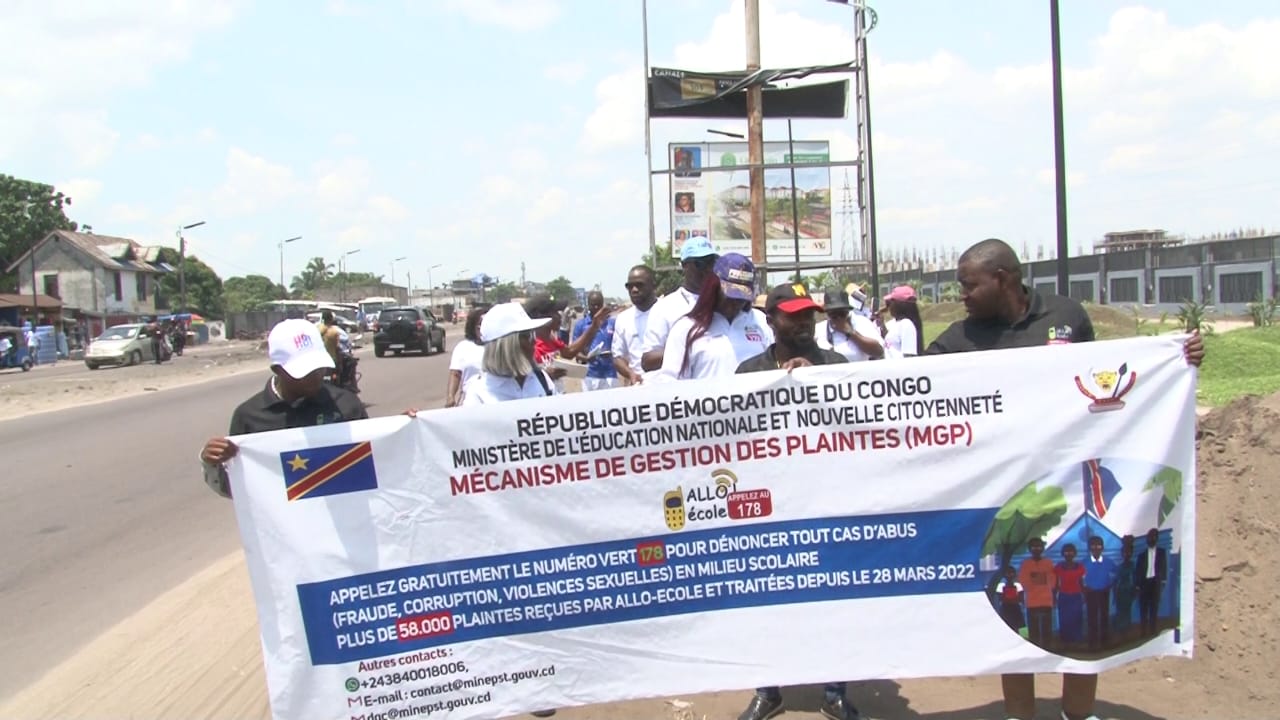
To mark its fourth anniversary of operations, a special event was organized in Kinkole at the Happy Day venue, overseen by its department head, Director Fleury Dala. Participants took part in a health walk starting from the Plaza entrance, punctuated by awareness-raising activities on the use of Allô-École.
The program included cultural and sports activities, recitations of poems dedicated to women and Allô-École, gift exchanges, and moments of fellowship. The day also served as an opportunity to pay tribute to women, who are often victims of abuse, through messages of support and motivation.
In this context, Mr. Serge Kimbila, from the DGC’s Communication and Press Department, wrote poems, notably “Women of the DGC, the Voice of the Nation,” which he read himself; “Allô-École, the voice that comforts,” read by MGP Office Chief Ida Cisuaka; and “Allô-École, the voice that protects,” read by Daniel Mayele, an officer in the MGP reporting office.
Speaking at the ceremony, MGP Office Chief Ida Cisuaka Cibanza noted that the most frequent complaints received by Allô-École concern teachers’ salaries, the mechanization of new schools, and late payments, particularly in rural areas. She also highlighted sensitive cases related to governance (abuse of power, corruption) as well as sexual violence in schools.
To this end, Ms. Ida Cisuaka Cibanza outlined the main challenges encountered in managing complaints. These include fear of speaking out and a lack of a reporting culture.
“We enforce a strict policy based on a survivor-centered approach, ensuring that sensitive complaints are handled only by authorized personnel,” she emphasized.
At the operational level, complaints received are sorted, tracked, and then forwarded to the Human Resources Directorate, which handles them on behalf of the administration and under the supervision of the National Complaints Management Committee (CNGP), explained Kévine Bouozock Belandze, an operator at Allô-école.
The MINEDU-NC’s MGP operates at four levels (central, provincial, sub-provincial, and school) and aims to strengthen student protection while promoting equity and inclusion in the Congolese education system. It is part of the fourth guiding principle of the 2024–2029 Five-Year Plan, which aims for a solid and equitable educational future focused on promoting equity and inclusion, while ensuring a safe and accessible educational environment for all.
Equity and inclusion are fundamental values that underpin all actions of the Ministry of National Education and New Citizenship in the Democratic Republic of the Congo.
Marie Shomba
Filter by structure or document type to find the right content.

For any report or information related to national education and new citizenship, call 178