Environmental education: EPST schools and ASBL Espace Texaf Bilembo join forces to raise awareness of Congo's biodiversity
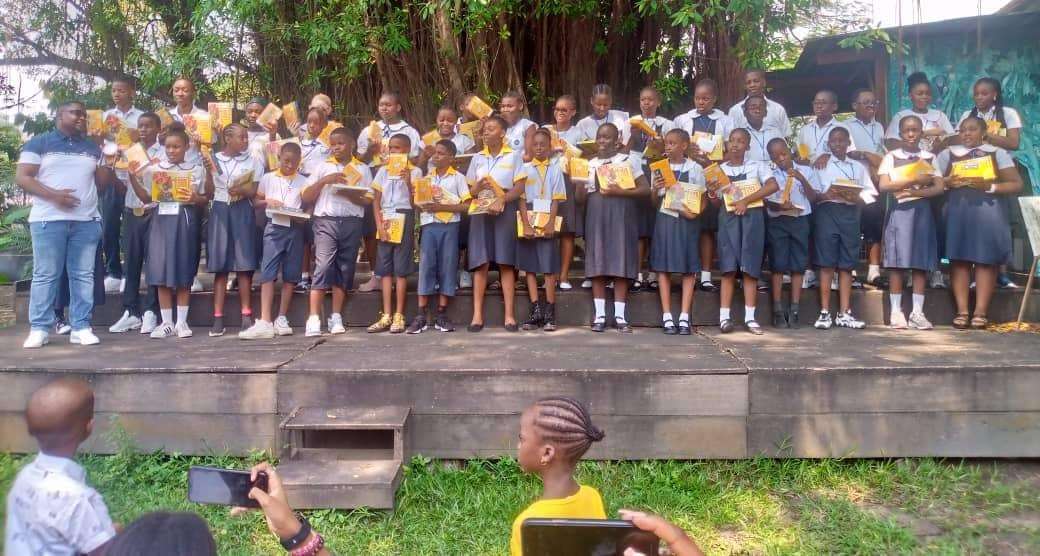
Espace Texaf Bilembo, a cultural center dedicated to educating the public about environmental and cultural issues in the DRC, organized an exhibition and workshop on the Congo’s biodiversity on Saturday, May 11, 2024, as part of the final presentation of its project titled “SOS Planète Congo.” Students from primary and secondary schools under the Ministry of Primary, Secondary, and Technical Education participated in the event as workshop facilitators on various environmental topics.
The overall objective of the activity was to raise awareness among young people, adults, and socio-political decision-makers regarding the issue of Congo’s biodiversity and the danger it has faced for several years, as the Espace Texaf Bilembo (ETB) has addressed in the implementation of its “SOS Planète Congo” project.
Student Awareness Raisers
Thus, the various guests at the May 11 event—including parents of students attending partner schools, children, businesspeople, activists from NGOs specializing in environmental issues, and technical and financial partners—were educated on the topic by the students through a series of workshops, performances, and informational and educational sessions. The workshop was designed and organized as a journey marked by stations where participants stopped to listen to presentations on environmental topics given by the students.
The route
Seven stations were meticulously and carefully designed and developed, with the students seamlessly coordinating their efforts to present and explain the topics assigned to them, acting as true educators. The tour began with an introduction to ancient Africa, featuring a typical Congolese village with its way of life, main activities, traditional medicine, art, and crafts that shaped the daily lives of our ancestors. The public presentation included a participatory approach with question-and-answer games.
The journey continued, in its middle section, with stations illustrating the significant transformation of lifestyles and activities that have impacted nature, altering biodiversity now exposed to danger, with real threats of extinction and disappearance of certain living beings that are nonetheless vital to ecological balance. The student ambassadors, who were honored by the ETB at the end of the activity, took turns discussing topics such as Congolese species threatened with extinction, the importance of biodiversity, national parks, waterways and forests, and slash-and-burn agriculture.
The final station was a participatory game focused on new attitudes and behaviors to adopt in order to protect the Congo. It was designed to reveal how human activities destroy the ecosystem. A compact block representing the Congo’s resources—each represented by a piece of wood in a color matching the nature of the activity—was constructed. The exercise involved removing a piece of wood without breaking the block, which was impossible to achieve. The students wanted to demonstrate the destruction of biodiversity caused by each of the activities involving the unlimited exploitation of a Congo resource. But hope is not lost. This was revealed in the next stage of the same exercise, which involved rebuilding the block each time a randomly selected participant provided the correct information about an activity that could help restore the Congo’s biodiversity.
The finale of the activity was a PowerPoint session for parents and chaperones on wordplay related to the environment. Mentioning one word can trigger several others that turn out to be its synonyms or antonyms. It was a fun and educational way to wrap up the day’s awareness-raising session. The session was led by ETB technicians who had trained the student ambassadors during rehearsal sessions over two weekends.
The EPST is proud of this
The Ministry of Primary, Secondary, and Technical Education is honored by such an activity, which embodies its commitment to environmental education as outlined in the school curriculum starting in kindergarten. This pride is all the more significant because the students involved in ETB activities are not only educated about the environment as an extension of the environmental curriculum but are also empowered to take an active role as guides or ambassadors—a role that some fulfilled with honor during the event on May 11, 2024.
The seven schools that sent students are the Bilombe School Complex (CS), CS La Colombe, CS Les Petits Lutins, Liziba High School, Mama Muilu Institute, CS Minzoto/Mont Ngafula, and Molende High School—two secondary schools and five elementary schools. The students were accompanied by their teachers, who served as cultural mentors.
Mark your calendars
The experience will continue with students from other schools on June 1, 2024, when Espace Texaf Bilembo will present a summary of the SOS Planète Project’s journey, in its phase supported by TMB Bank.
It should be noted that the Espace Texaf Bilembo was founded in 2013 by Ms. Chantal Tombu and Alain Huart. This center for the promotion of Congolese culture is housed in the disused premises of the Texaf factory, in the Gombe district. It serves as a true model for promoting cultural and heritage tourism by breathing new life into a space that contributed to the Congo’s growth. Espace Texaf Bilembo features a bookstore, a library, exhibition halls, and a magnificent garden. It is also involved in the development of environmental education textbooks.
Fleury DALA DIANA