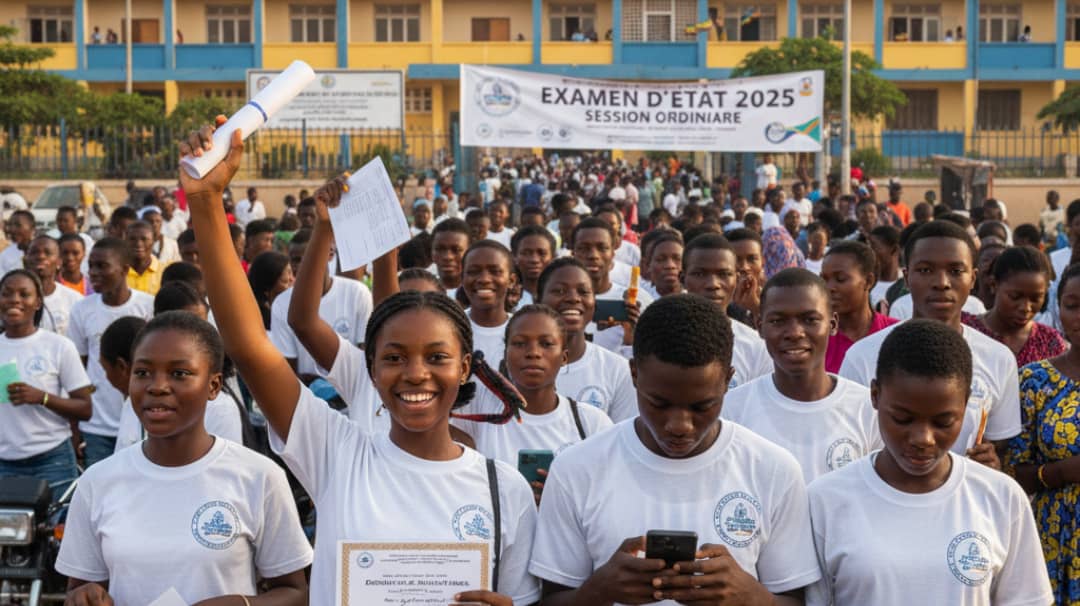
EXECUTIVE SUMMARY: The challenge of massification in the DRC Image generated with Gemini
As the 2025–2026 school year gets underway and preparations for the next session of the State Exam (EXETAT) are in full swing, analyzing last year’s performance is a strategic imperative. I (naturally) had early access to the 2025 Session Report, an essential comparative study that breaks down the results by subject and by province. I would like to share with you here the most striking results—those that reveal interesting trends. This is an opportunity to launch an informed discussion!
The EXETAT’s Demographic Boom
Changes in Participant Numbers and Pass Rates from 1967 to 2025
The first piece of data that stands out in this report is the incredible growth in the number of EXETAT participants since its inception. The Congolese education system has achieved the feat of organizing this exam without interruption since 1967—a powerful testament to its resilience despite the turbulence of our national history (wars, political and economic crises). The contrast is striking: we have gone from 3,237 final-year students in 1967 to 1,076,572 in 2025. This represents a staggering increase of over 33,162% in 58 years!
As illustrated by the graph above, the notable increases starting in 2019 are most likely a delayed effect of the widespread implementation of free primary education. This policy triggered a wave of mass enrollment that is now reaching the secondary level. The peaks observed in 2023 and 2025 only confirm this trend. The question is: is our system ready, in terms of infrastructure and quality, to absorb this exponential growth? We will return to this.
Success Rate (Reflecting National Crises)
The same graph reveals a figure just as crucial as the number of enrolled students: the concurrent evolution of the EXETAT success rate (percentage of participants who pass). Analysis of this curve is enlightening. First, we observe the Golden Age (up to 1977), when the overall success rate consistently stood above 50%, reflecting a period when the education system seemed to maintain a high performance threshold. Next came the Dark Years (1978–1993), a period when average overall performance plummeted. Our generation remembers well the painful years of 1992 and 1993, which coincided with major political and social crises (looting, tensions surrounding the Sovereign National Conference).
The correlation is striking: when the country suffers, schools pay a heavy price. Finally, we observe a Revival and fluctuations (Post-1994). Starting in 1994, results began to improve again, but remain fragile. The years 2001 and 2007 appear as turning points, highlighting the impact of residual instability or educational policies requiring adjustment. It is worth noting that the introduction of the new grading system based on multiple-choice questions (MCQs) in 2007 was a major reform. This digitization significantly improved the reliability of results and reduced grading time, marking a break with the old manual system of punch cards.
This parallel between the evolution of participant numbers, the pass rate, and the historical events that have marked the history of the DRC is a wonderful field of investigation for educational historians and public policy analysts. These curves are much more than mere statistics; they are the nation’s numerical memory. Beautiful stories and hard-learned lessons are hidden within this data. Don’t you think?
EXETAT 2025 Focus
Let’s now focus on the data from the 2025 EXETAT session, breaking down the trends in subject choices. The following analysis reveals four key insights: the most popular tracks, their overall success rates, and the comparative performance of girls and boys.
The Top 10 Highest-Performing Tracks in EXETAT 2025
The Famous General Education Track
Unsurprisingly, the track that attracts by far the largest number of participants is General Education (PG). This massive popularity stems from multiple factors. On the one hand, it is still perceived as the most accessible path (the “easiest”), and on the other hand, it is the most widely offered option and the “least expensive” to organize nationwide, in the eyes of many promoters.
It is worth noting here that this track is undergoing a major overhaul for the 2025–2026 academic year to better serve its original purpose: training elementary school teachers in anticipation of the launch of teacher training institutes that will offer a three-year post-baccalaureate program.
To my great delight, the second most popular track is Science. An encouraging sign for the country’s scientific development! Several technical tracks are in the Top 10, and that is also good news.
Discrepancy between enrollment and performance
An analysis of the success rates for the Top 10 tracks reveals a striking imbalance. On the one hand, the track that attracts the largest number of students, General Education (PG), was not the one with the highest success rate. On the other hand, it is the fields often considered more demanding—notably Sciences (yay!), Business and Management, and Latin-Philosophy—that boast the highest success rates.
While PG is essential for building the foundation of education, its relatively poor performance raises questions about the quality of training provided to future teachers. Quantity must not come at the expense of quality, especially in strategic fields.
Girls’ performance challenges stereotypes
Girls’ performance in the Top 10 tracks
Boys’ performance in the Top 10 tracks
Analyzing pass rates by program is fascinating, but it becomes truly meaningful when the gender dimension is incorporated. This cross-analysis is essential to determine, for example, whether the low pass rate in General Pedagogy (PG) is exacerbated by a performance imbalance between girls and boys, and above all, to break down stereotypes regarding scientific and technical fields.
The two charts above, detailing the Top 10 courses by success rate for boys and girls, reveal major surprises. Contrary to popular belief, girls achieve higher success rates than boys in several fields traditionally considered “masculine” or “difficult.” The gap is significant: in Science, 83% of girls pass compared to 80% of boys. In Latin-Philosophy, the gap is even more pronounced: 89% of girls pass, compared to only 80% of boys. Even in a technical track like Automotive Mechanics, although girls are in the minority, they have a higher success rate (72% for girls versus 63% for boys).
These figures send a strong message. Young women who choose non-traditional fields perform better than their male counterparts, challenging the gender-based distribution of talents and aptitudes. Regarding the most popular track, General Education (PG), the success rate for girls is one percentage point lower than that of boys. This gap, though small, occurs in the most popular track.
Ultimately, these data not only highlight the urgent need to improve quality in high-enrollment fields (such as PG), but above all underscore the untapped potential of girls in scientific and technical fields. If girls perform better in fields where they are fewer in number, isn’t it time to break down cultural and social barriers to encourage more young girls to pursue these promising fields?
Conclusion
It is tempting to delve into other data from the report—particularly the detailed analysis of performance by province—but this article is already long enough! For now, this dive into the EXETAT 2025 figures has confronted us with two major realities: the exponential and inevitable growth in the number of participants (an increase of over 33,162% in 58 years), and the immense and underutilized potential of girls, who are outperforming in several scientific and technical fields, challenging stereotypes.
Improving the quality of our education system remains for me a constant concern and a task that does not follow a straight path. There are no magic formulas, but rather a set of levers we must act upon simultaneously: modernizing curricula, improving teachers’ working conditions, providing initial and continuing training, and strengthening administration. Our system is making considerable efforts to absorb this exponential growth, demonstrating a resilience and determination that are our true strength. Even though the political, security, and socio-economic context is not helpful, this ability to maintain the EXETAT since 1967 proves our unwavering commitment to education.
The 2025 Session report does more than simply state a fact; it paves the way for concrete actions (such as improving the design and administration process, and better coordinating national exams). It is on this factual basis that we must collectively build the future.
We are the Ministry of National Education; we are preparing our children’s future; we are building the nation.
Raïssa MALU
Minister of State, Minister of National Education and New Citizenship