Actualités
16 April 2026

This Monday, July 28, 2025, we are proud to launch the 58th regular session of the State Examination (EXETAT) across our entire country, at 3,165 testing centers, including 13 located outside our borders in Angola, Uganda, Rwanda, Burundi, and Tanzania.
Since its very first session in 1967, the State Examination has always been a pillar of our educational system, an annual event that marks a milestone in the journey of hundreds of thousands of our young people. Despite past challenges and the persistent insecurity in the northeast of the country and the Kwamouth territory in Mai-Ndombe Province, our determination to guarantee access to education remains unwavering. It is thanks to the resilience of our people and the commitment of the General Inspectorate that we have been able, once again, to organize this session under acceptable conditions.
But beyond this historical continuity, I would like today to highlight the technical innovations we have implemented since the 2024 session. Indeed, from the moment I took the helm of this ministry, our goal has been clear and ambitious: to strengthen the reliability and transparency of the grading and publication of EXETAT results.
The EXETAT 2025 "Postcard"
Before discussing these innovations, let’s take a moment to look at the 2025 figures. This is what the General Inspectorate calls the “postcard” of the session, and it is particularly telling this year. To give you an idea of the scale of the State Exam in the DRC, it is interesting to compare it to the famous French baccalaureate, which in 2025 had 724,633 registered candidates.
The Long Cycle: An Impressive Turnout
For the long cycle, we recorded a record number of 1,079,341 candidates—nearly 350,000 more than the French baccalaureate! A figure that attests to the vitality of our youth and their desire for education. Of this total, 42.9% are girls.
Compared to the 2024 session, this year saw an increase of 117,054 candidates, representing a 12.1% rise. But the most encouraging news is undoubtedly the growth in female participation: we have 57,156 more girls, a 14.0% jump! This is a development of which we should be proud, as it demonstrates the commitment of our young girls—and their families—to building their future, and of our educational system to opening every door for them.
The top three educational provinces with the highest number of candidates for the upper secondary level are Haut-Katanga 1 (94,670 candidates), followed by Kinshasa-Lukunga (43,327 candidates) and Kinshasa-Tshangu (41,956 candidates).
As for gender parity, it is with great satisfaction that we note remarkable proportions of girls. Ituri 1 leads the way (51.7% girls), closely followed by Kinshasa-Mont Amba (51.5%) and Kinshasa-Lukunga (51.5%).
The Short Cycle: Professional Excellence on the Rise
The short vocational program is not to be outdone. It attracted 6,022 applicants, including 1,020 girls. Compared to last year, we recorded an increase of 605 applicants, or 11.1% more. The presence of girls, although stable with 14 additional applicants, is a trend we will continue to encourage, as they are essential to the development of technical professions.
The top three regions in terms of applications are South Ubangi 1 (641 applicants), Upper Lomami 1 (564 applicants), and Central Kongo 2 (389 applicants).
In terms of female participation, Kasai Oriental 2 (93.9% female) stands out, followed by North Kivu 1 (86.3% female) and Ituri 1 (34.6% female). These figures remind us that in our provinces, women’s professional futures are already a reality.
These statistics are not mere numbers. They represent thousands of dreams, hopes, and efforts. And to ensure these efforts are rewarded with the utmost fairness, we have implemented groundbreaking technical innovations. This is what I will explain to you now.
The Digital Revolution
As Minister, my priority has always been to ensure equity for every student and the credibility of our education system, not only nationally but also internationally. To achieve this goal, we have carried out a true digital transformation of the State Exam in the DRC. Our efforts have focused on several strategic projects:
We first modernized the crucial registration process. Gone are the manual methods, which were prone to errors and fraud. Today, registration takes place via a secure digital platform. Over 4 million students have been accurately identified, and we have eliminated over 12 million paper documents—a real boost for the environment! This digitization has also helped secure students’ personal data and speed up the production of exam badges and diplomas.
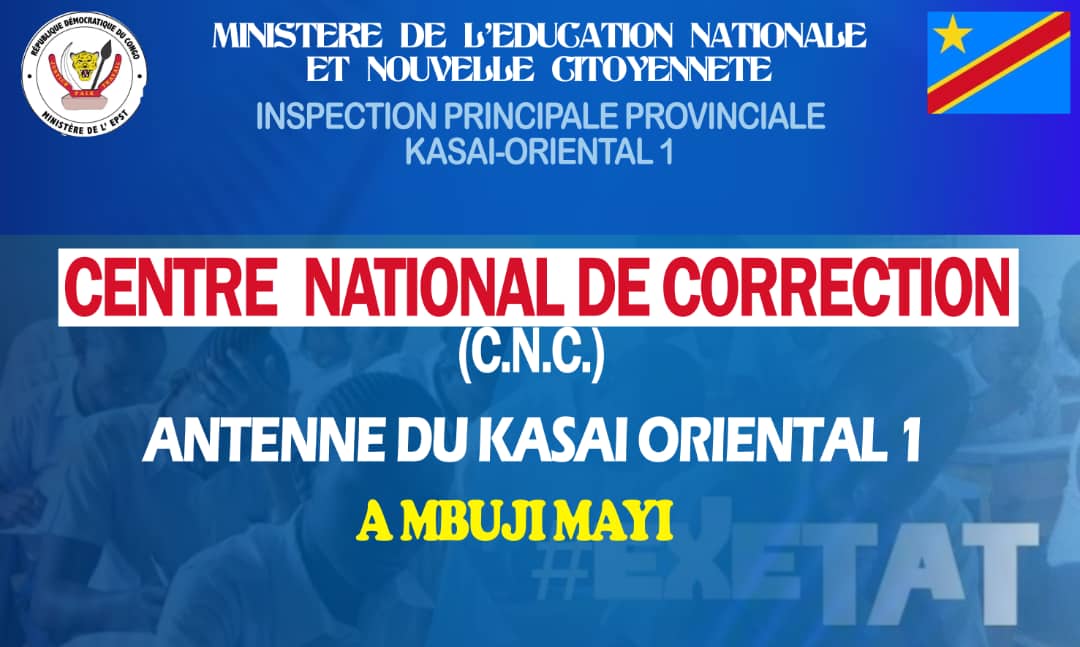
For years, processing exam papers in Kinshasa was a logistical nightmare—costly and risky. In a nutshell: it made no sense! We therefore decided to decentralize this process—a first in the history of the modern State Exam. The big news for the 2025 session is the opening of two modern exam-scanning centers, one in Mbuji-Mayi (Kasaï-Oriental 1) and the other in Lubumbashi (Haut-Katanga 1). Each center is a small hub of reliability, with five dedicated rooms: a preparation room, a scanning room, a server room, a control room, and a monitoring room. Exam papers are thus processed digitally and sent to the grading centers in Kinshasa, allowing us to reduce the overall processing time for results by 30 to 40%.
Diploma fraud is a scourge we have decided to eradicate. Thanks to the E-Diploma platform, every academic credential is now tamper-proof, traceable, and available for life. A simple QR code or secure link allows universities, embassies, and employers to instantly verify the authenticity of a diploma—an innovation that strengthens the credibility of our education system on a global scale. The DRC is thus becoming a pioneer of African public solutions utilizing blockchain.
To make grading even more reliable and efficient, we have introduced a new technology powered by Artificial Intelligence: S-Note Manager. This innovation enables automatic grading of exams while maintaining a high level of human oversight by experts from the General Inspectorate. This results in significant time savings for our graders and more reliable and consistent results for our candidates.
Thus, the digital transformation of the State Exam in the DRC is much more than a simple modernization. It is a commitment to transparency, sovereignty, and equity for every young person in our country. We are convinced that these reforms, with the support of our partners and the community, will ensure a bright future for our youth and consolidate our education system’s position among the best on the continent.
From Exam Reform to Education Reform
That said, technology alone does not solve all problems. Upon our arrival in June 2024, we first focused our efforts on the end of the process—namely, grading and the release of results. It must be said that old habits die hard, and we harbor no illusions about the state of our exam centers. That is why we reiterate our call for vigilance: we remind all candidates and stakeholders once again that it is essential to eliminate fraud and cheating, lest we jeopardize our children’s future. Rest assured, anyone found guilty of fraud will be severely punished.
We will not stop there. Starting next school year, 2025–2026, we will tackle the root of the problem: the quality of education and that of the state exam itself. A process to modernize all educational curricula is underway, and a new pedagogical approach based on skills development (the situational approach) will be implemented across the board. The State Exam will be modernized to better reflect the acquisition of knowledge and assess skills.
Conclusion
Ultimately, the digital transformation of the State Exam is much more than a simple technical modernization. It is a profound commitment to transparency and equity for every young person in our country. It is a powerful message of resilience, demonstrating that despite the turbulence of our history and today’s challenges, our children’s future remains our guiding compass.
Our innovations—from digital registration to decentralized scanning, blockchain-secured diplomas, and AI-assisted grading—aim to build a stronger and more credible education system.
But we know the journey does not end there. It is by also focusing on the quality of education that we will build the human capital that will be our pride tomorrow. By modernizing our curricula and adapting the state exam, we are committed to educating young people who are not only well-educated but also competent and ready to take on the challenges of our world.
Good luck to all the candidates in this 2025 session. The entire country is behind you.
We are the Ministry of National Education; we are preparing our children’s future; we are building the nation
Raïssa MALU Minister of State, Minister of National Education and New CitizenshipFilter by structure or document type to find the right content.

For any report or information related to national education and new citizenship, call 178