Actualités
16 April 2026

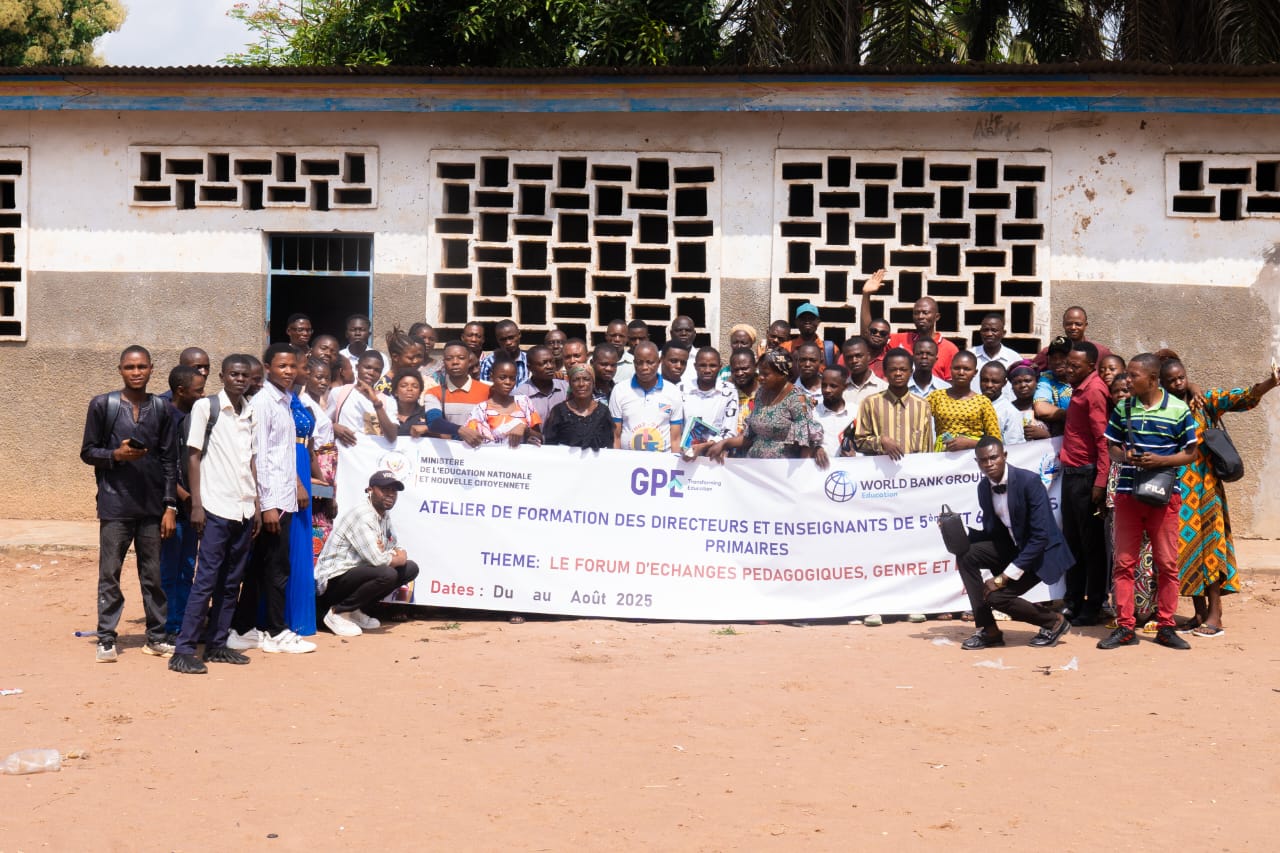
As part of the Project to Improve the Quality of Primary Education (PEQIP), the Ministry of National Education and New Citizenship (MINEDU-NC) has taken a significant step forward in building the capacity of stakeholders in the education sub-sector.
According to statistics from SERNAFOR Primary of the General Inspectorate of National Education, 12,563 principals and teachers of 5th and 6th grades in public primary schools received structured training, organized in nine targeted educational provinces between August and December 2025. This initiative was funded by the Global Partnership for Education (GPE) with the aim of achieving sustainable improvements in the quality of learning.
In fact, this was a large-scale initiative implemented at 170 sites spread across the sub-districts of nine educational provinces. This specifically includes the educational provinces of Ituri 1, Ituri 2, Ituri 3, Kasai 1, Kasai 2, Kasai-Central 1, Kasai-Central 2, Kasai-Oriental 1, and Kasai-Oriental 2.
Regarding the targeted outcomes, strong participation among beneficiaries has been reported, slightly exceeding projections. Of the 12,560 participants initially expected, 12,563 were actually trained, representing a completion rate of 100.02%.
There were 4,184 school principals, who ensure educational quality in schools, and 8,396 teachers on the front lines of instruction.
Certain educational provinces stood out in particular for the scale of their mobilization, notably with the participation of 2,325 participants in Kasaï 2, 2,306 in Kasaï-Central, 2,265 in Kasaï 1, 1,955 in Kasaï-Oriental 1, and 1,008 in Ituri 3.
This achievement is the result of a structured and phased approach implemented in advance. In August 2025, an initial strategic training phase was organized for 340 provincial educational supervisors, inspectors, and educational advisors—including 108 women—tasked with training teachers on managing large-classroom settings, the pedagogical exchange forum, and concepts of gender and equity. These supervisors then ensured the dissemination of these skills to the benefit of principals and teachers in the targeted provinces where they were deployed.
In the context of implementing free primary education in the Democratic Republic of the Congo, this approach helps mitigate the challenges associated with the significant increase in class sizes in public schools—a phenomenon that affects the quality of learning.
However, female participation in this large-scale training program reveals a persistent challenge: only 1,868 women were recorded among the 12,563 participants trained, representing 15% of the total cohort.
This finding calls for strengthened strategies to increase women’s participation in the teaching workforce and in leadership roles in public primary schools, in line with national commitments to equal opportunity.
Regarding the implementation plan, the nine targeted educational provinces have 170 organized training sites and 340 mobilized trainers.
Beyond the numbers, this initiative is part of the government’s efforts, through MINEDU-NC, to improve the quality of primary education in the DRC. Its true impact will now be measured in the classrooms, at the heart of the pedagogical relationship between teacher and student. By strengthening the capacities of teachers and principals on the identified challenges, PEQIP not only contributes to improving student support and the quality of learning but also promotes teaching practices that are sensitive to gender and equity.
Marie Shomba
Filter by structure or document type to find the right content.

For any report or information related to national education and new citizenship, call 178