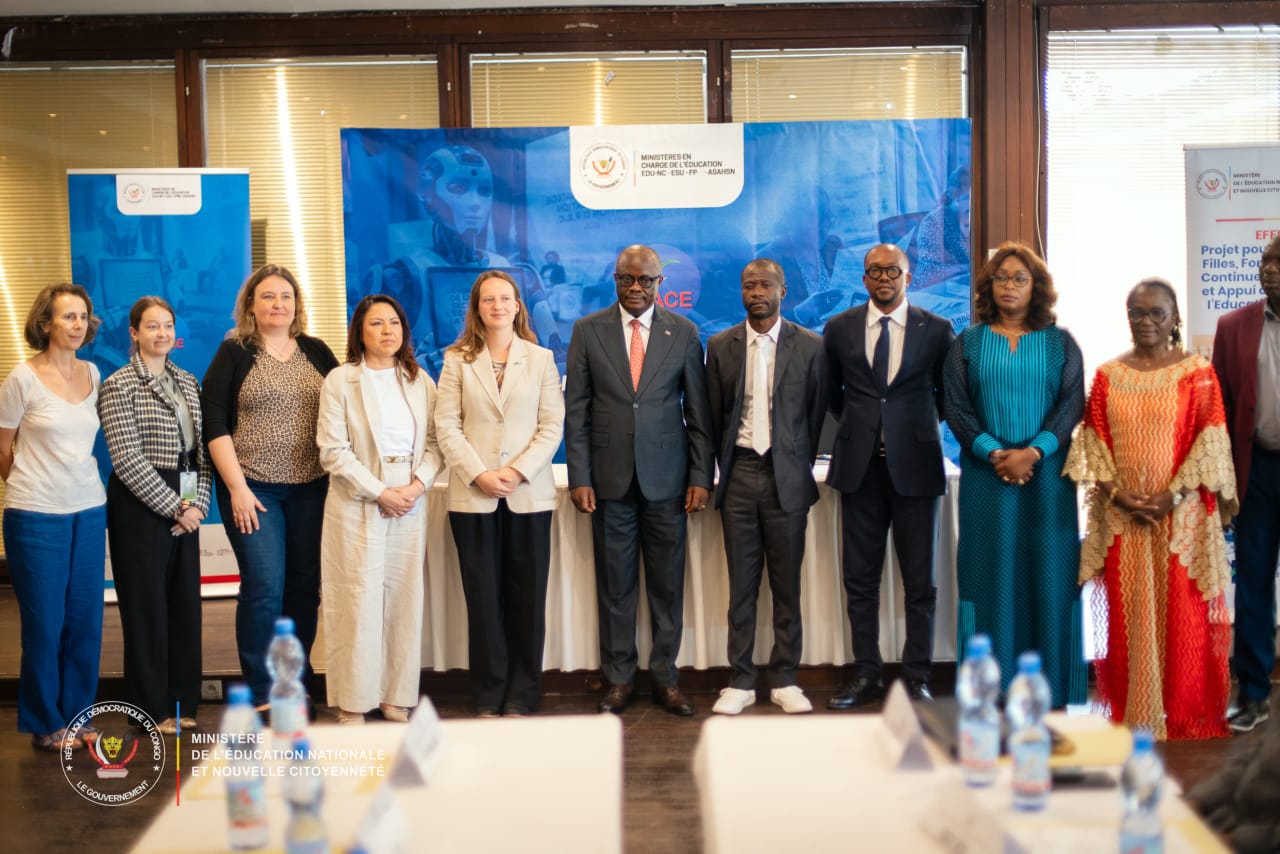
The Sultani Hotel hosted the special session of the Sectoral Consultation Committee (SCC), held on Thursday, September 25, and organized by the Permanent Secretariat for Support and Coordination of the Education Sector (SPACE). This meeting facilitated constructive discussions regarding the validation of requests to revise the trigger indicators for additional funding from the Global Partnership for Education.
The main objective of this session was to prepare for the strategic dialogue leading up to the mid-term review of the Partnership Pact established between the Democratic Republic of the Congo and its education partners. The indicators in question, which were set to be achieved by 2025, could not be met due to various obstacles, both political and technical.
Below are the requested revisions for each indicator:
Indicator on the implementation of a unique identifier for teaching staff by 2025
Extension of the deadline to 12 months, i.e., until 2027;
Modification: instead of merging databases, the process will now start from a single database;
Change in one of the verification methods (Kasaï Central 1 instead of Kivu 1).
Indicator of the effective retirement of 4,000 teachers;
Extension of the deadline to 12 months, i.e., December 31, 2026;
Change in verification source: no longer PREACE reports, but DINACOPE payment reports.
Indicator of at least 50% state funding in 2025 for the budget related to data collection, publication, and dissemination of the statistical yearbook;
Extension of the deadline to 12 months, i.e., December 31, 2026;
Change in verification source: no longer the accountability law, published one year after the end of the budget execution period, but the budget execution report.
In his speech, the Acting Secretary General of the Ministry of National Education and New Citizenship (EDU-NC) praised the quality of the contributions that led to the approval of the requests. He announced his intention to submit this document to the minister in charge before September 30.
“These revisions aim to ensure the relevance, feasibility, and sustainability of the targeted outcomes,” he emphasized.
The session brought together a diverse range of participants, including representatives from the ministries responsible for education (EDU-NC, ESU, FP, ASAHSN), civil society organizations, labor unions, religious groups, and educational partners. This diversity reflects the collective commitment to improving the education sector in the DRC.
This validation of the indicators is an essential step toward achieving the set objectives and strengthening cooperation among the various stakeholders in education.
Ouriel Mangitukwa