Their names are Marisha and Isabelle. Two sisters, two teenagers from Goma, brutally torn from their home, their school, their childhood. One day in March 2025, the sound of gunfire drowned out the teachers’ voices. Their neighborhood was caught in the fighting. Without papers, without support, but not without courage, their parents set out on the road with their two daughters. On foot. By truck. By plane. From one city to another. In silence. Toward the south. Toward peace.
Their journey lasted several weeks. Miles covered without certainty. Sleepless nights. Military checkpoints. Hostile stares. But at every moment, their mother repeated the same thing: “
I want them to finish school.”
A school found, thanks to political will
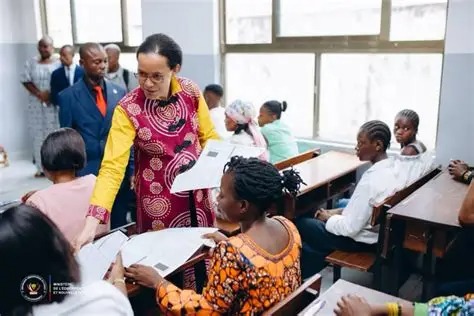
Arriving in Lubumbashi, exhausted, without report cards or grade books, they were directed to a school in the city. The school hesitated: there was no proof that they had been in their final year in Goma. But then, an order from Minister Raïssa Malu, implemented by Inspector General Hubert Kimbonza, changed the course of their lives:
“Any student displaced by conflict may be enrolled in a school of the Republic upon simple declaration, taking into account their actual level.”
The principal enrolls them. The school welcomes them. The Republic recognizes them:
They resume classes in April. They will have to get to know their new teachers and their new friends. They have no notebooks, no uniforms. But they have a fierce determination to succeed—for themselves, for their mother, for their father, for Goma.
A resilience stronger than war
For three months, they study every night, two to a bed, by the light of a lamp. They share the books they’ve borrowed. They quiz each other. They go back over the pre-war exercises, the ones that were never graded.
They never spoke of what they had seen, nor of what they had lost. But every morning, in the courtyard of the school in Lubumbashi, they stood up with a dignity that moved everyone: the dignity of those who refuse to be broken.
In July, they take the State Exam. In August, the results come in. Both passed with flying colors: 65% for Isabelle and 72% for Marisha. Tears. Silence. Then an outburst of joy.
The school principal would later say:
“It was as if history itself had just been contradicted. They had lost everything, except the essential: hope.”
School as the Republic’s Last Refuge
This story is not just about two sisters. It is about fair public policy, about a directive designed not to manage numbers, but to protect lives. It is proof that the Congolese school system, when well-run, can be stronger than war.
Thanks to the compassionate vision of Minister Raïssa Malu and the dedication of school inspectors and principals, these two girls—who represent thousands in their situation—will not be a lost generation. On the contrary, they are the faces of a nation rising again.